AI Transformation & Adoption

AI transformation is a change programme, not a technology rollout.

A disciplined approach connects organisational priorities, process redesign, responsible technology choices and the people who will use them — then proves value before scaling.

Change Management at a Glance

AI adoption needs active change management at every stage

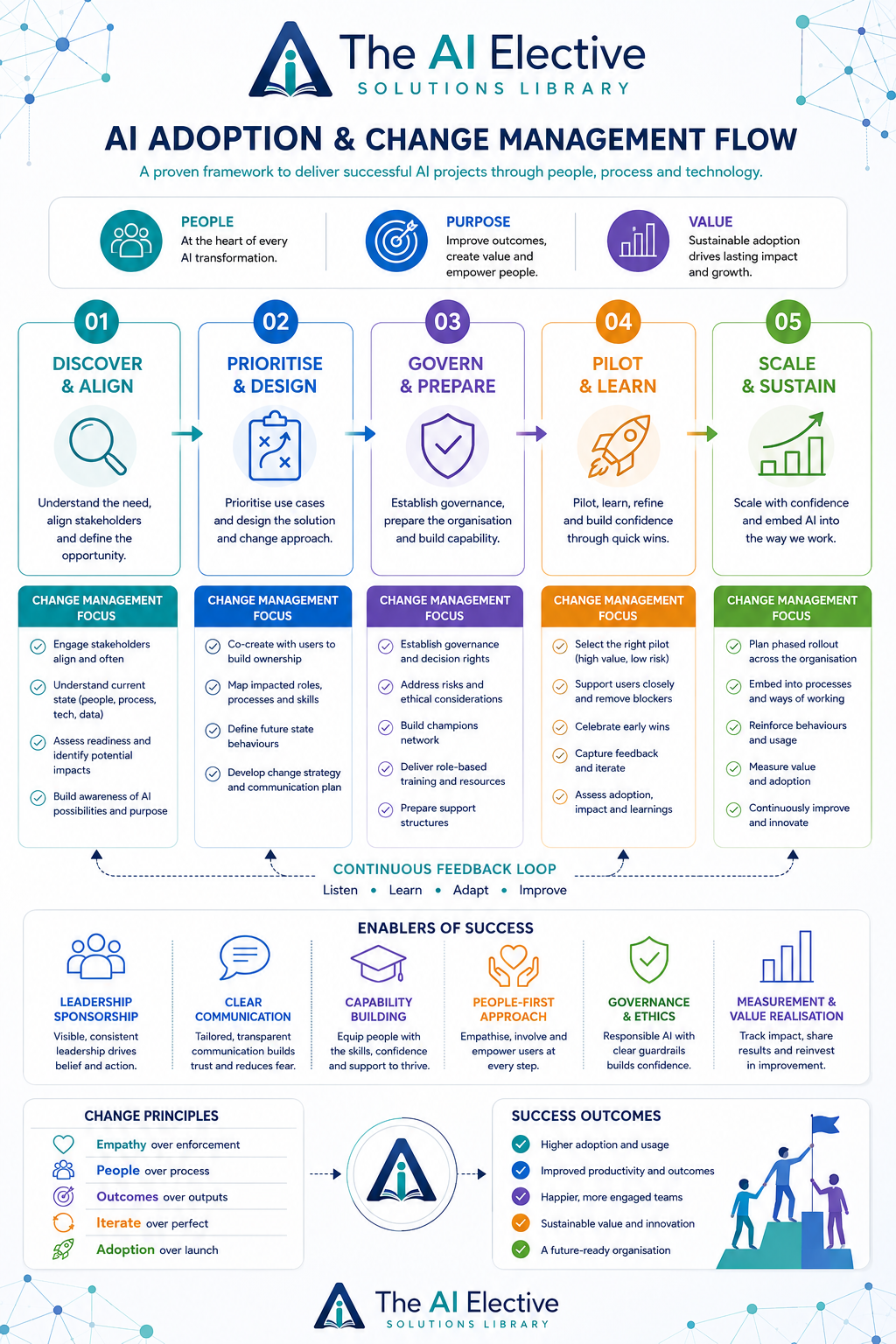
The flow below brings the transformation approach together visually — from discovery and stakeholder alignment through governance, piloting, adoption and sustained value.

The AI Elective AI Adoption and Change Management Flow infographic showing five stages: Discover and Align, Prioritise and Design, Govern and Prepare, Pilot and Learn, and Scale and Sustain.

Transformation Framework

From organisational problem to sustained adoption

This is the approach I use when thinking about AI transformation in education: establish the case for change, understand the work, design and assure the intervention, prove it through a bounded pilot, then scale only when the evidence supports it.

01

Discover & Align

Start with strategy and the current state. Identify the organisational problem, map stakeholders and workflows, establish executive sponsorship and agree what success should look like.

  • Strategic objectives & case for change
  • Stakeholder and process mapping
  • Readiness, data and capability assessment
  • Baseline measures and benefits hypothesis
02

Prioritise & Design

Turn problems into a prioritised portfolio of use cases. Redesign the workflow before selecting technology and define where human judgement, approvals and escalation must remain.

  • Value, feasibility and risk prioritisation
  • Future-state process design
  • Microsoft stack / architecture decision
  • Success measures and acceptance criteria
03

Govern & Prepare

Build assurance and adoption into the project plan rather than adding them at launch. Clarify ownership, controls, communications, training, support and the conditions required to proceed.

  • Roles, decision rights and governance
  • Privacy, security and responsible AI controls
  • Risk / issue / dependency management
  • Change, communication and learning plan
04

Pilot & Learn

Test a bounded use case with representative users in a safe environment. Track technical performance, user behaviour, confidence and operational impact, and use feedback to refine the solution.

  • Prototype and controlled pilot
  • Human-in-the-loop testing
  • User feedback and adoption support
  • Benefits tracking and lessons learned
05

Scale & Sustain

Move beyond the pilot only when agreed evidence and controls are in place. Roll out in manageable waves, build internal capability and keep measuring value as the technology and organisation evolve.

  • Go / no-go review
  • Wave-based deployment
  • Champions, support and capability transfer
  • Continuous improvement and benefits realisation

Project discipline

What sits underneath every phase

AI work still needs the fundamentals of good programme and project management. The technology may be new; the need for clear ownership, controls, evidence and communication is not.

Scope & ownershipDefined problem, sponsor, process owner, users and boundaries.
RAID & governanceRisks, assumptions, issues, dependencies, controls and decision routes kept visible.
People & adoptionStakeholder engagement, honest communication, progressive learning and accessible support.
Benefits & evidenceBaseline → target → pilot evidence → benefits realisation, using usage, quality, time, confidence and outcome measures.

Principles

Technology is only one workstream

Problem before product

Do not automate a poorly understood process. Diagnose the work and redesign it first.

Governance by design

Security, privacy, safeguarding, human oversight and accountability shape the solution from the beginning.

Adoption by design

People need to understand why the change matters, what will change, what AI cannot do and where support is available.

Evidence before scale

A successful demo is not transformation. Scale decisions should follow measured operational value, user adoption and acceptable risk.